From a script for myself to a product: five months of claude-agents-bar
What I had to add to a working script so that a stranger could install it. An installer, diagnostics, 21 recorded decisions and 16 releases.
The first version of claude-agents-bar was a single file: a menu bar icon that shows the state of Claude Code sessions (I already wrote about it). When I decided to publish it, it turned out that the gap between "works for me" and "anyone can install it" holds noticeably more work than the script itself.
What the project has now
In five months, from May to October 2026, there were 16 releases. As of today the project has:
- a one-command install through Homebrew and a manual path for those who don't have it;
- the
setup,teardownanddoctorcommands; - 21 recorded architecture decisions;
- 696 tests;
- 8 interface languages;
- a project page with screenshots and a live example of the menu;
- documentation on configuration and on troubleshooting.
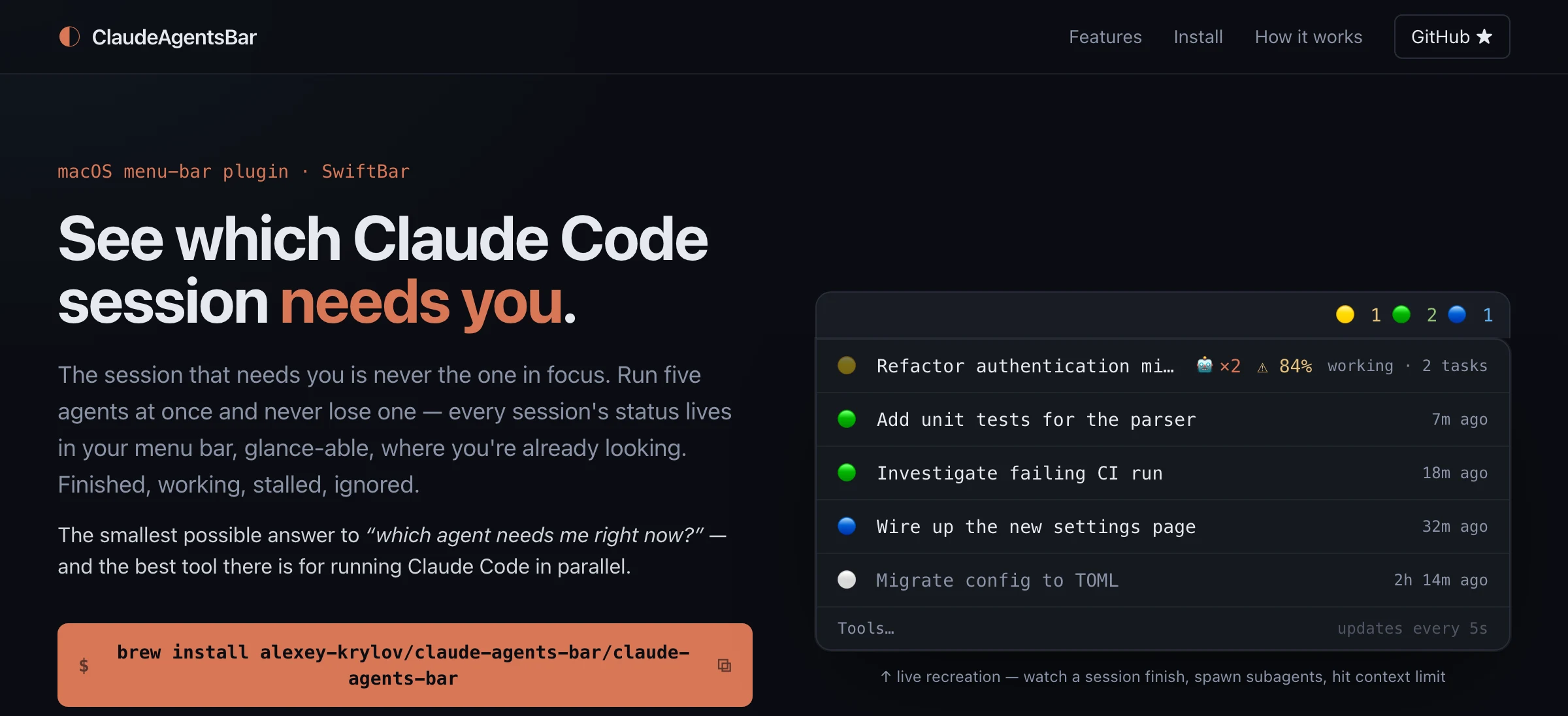
The script that solved my own problem was short of a product by an installer, diagnostics and recorded decisions. The rest can be added as requests come in.
An installer that doesn't break other people's setup
The tool plugs into the Claude Code settings, and a person already has their own hooks there. A naive install would overwrite them, so the installer appends its entries to the existing ones, but first saves a timestamped backup. Running the install again is safe, and teardown removes what it added.
For me this is the main requirement for an install: assume a machine that already has someone else's settings on it.
Diagnostics instead of correspondence
The first thing that happens after publishing: it doesn't work for someone, and they don't know why. There are many possibilities: a required utility is missing, the Python is the wrong one, the hook isn't registered, the state file isn't being updated. The doctor command checks all of this itself and says what is missing.
Decisions worth recording
There are 21 recorded architecture decisions. One of them: a plugin for an existing application instead of a program of my own. I run the project alone, and rebuilding and signing an application on every change would eat time I don't have anyway.
Another: locking the state file by creating a directory. The usual locking utility isn't installed on a clean macOS, and the file has three writers: the session hook, the subagent hook and the plugin itself.
The third is about links when installing through Homebrew. At first they pointed into the directory of a specific version, and that directory disappears on upgrade. I fixed this in June with a separate decision.
I record them so that a couple of months later I can see why it was done this way and which options have already been rejected.
Small improvements
Some of the improvements don't look serious, but they came out of daily use:
- a compact mode for laptops where the icon hides behind the screen notch;
- custom sounds and quiet hours for notifications;
- a repeated notification if a session is waiting for permission and nobody has answered it (the interval doubles: 10, 30, 70, 150 minutes);
- a warning when the session context is more than 80% full.
Weak spots
- the plugin will need maintenance: every Claude Code update can change something in the format of the files it relies on;
- I can't check all the translations into eight languages myself;
- there are many tests, but they check the logic, not how the menu looks on a particular screen;
- I don't know how many people use it.
It turned out the way it looked at the start: the installer, the diagnostics and the written-down decisions took more work than the menu bar icon itself.
Tags: Agents, Claude Code, Product, Tooling
Read next
claude-agents-bar: every Claude Code session, in the menu bar
A SwiftBar plugin that shows which Claude Code sessions are working, waiting on you, or done - built on hooks and JSONL transcripts alone.
An autonomous pipeline for Claude Code: from issue to merge
A queue of issues, headless sessions in separate worktrees, two gates and a merge into an integration branch. What came out of it and what had to be reworked.
A console for the agent factory: a menu bar item and an editor extension
How to watch an agent pipeline without opening the tracker. What the menu bar shows, what moved into the editor and why neither of them stores anything.
Comments